
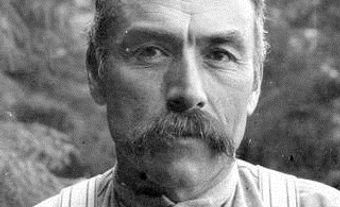
Courtesy of Canadian Museum of History
Charles Edenshaw is considered one of the most influential Indigenous artists of the late 19th and early 20th centuries. Edenshaw was born in Skidegate, Haida Gwaii, in 1839. His life and work are inextricably linked to the cultural heritage of the Haida people. His contributions are not only evaluated by his craftsmanship but also by his role in the preservation and innovation of Haida traditions during significant cultural shifts.
Edenshaw, a member of the Stastas Eagle lineage, worked as a carver under the guidance of his uncle, John Robson, from 1878 to 1881. Edenshaw subsequently embarked on the construction of a memorial pole for his mother, Qwa’Kuna, with Robson’s assistance, thereby establishing the groundwork for his future as a master craftsman. His creations encompassed a diverse array of materials, including wood, argillite, and precious metals. He was renowned for his dynamic, flowing forms, which were a testament to his proficiency in traditional Haida art. The “Sea Bear Bracelet,” one of his most renowned pieces, is characterized by an intricately carved silver band, and the bared toothy smile of an animal. Furthermore, his ability to animate Haida stories through his art is exemplified by his early argillite platter, which depicted panicked creatures in a canoe above a thrashing sea monster.
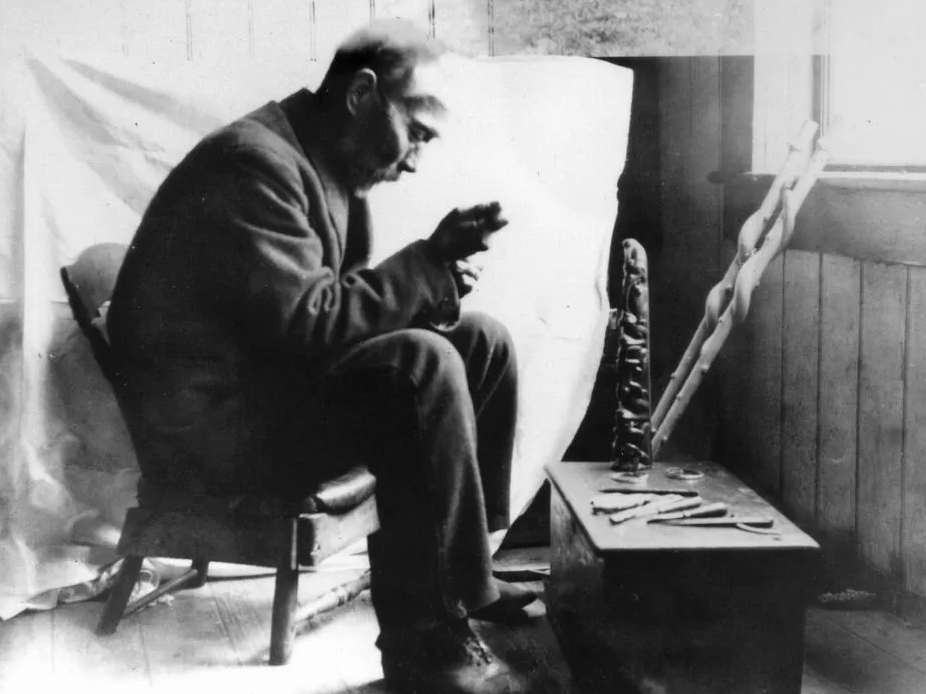
Haida carver Charles Edenshaw at work. Undated photo from Museum of Anthropology, University of B.C. Vancouver Sun.
Edenshaw made a substantial contribution to the recording and documentation of the Haida language and culture by collaborating with museum anthropologists, curators, and collectors throughout his career. His works, which include painted and carved kerfed boxes, gold and silver jewelry, and ceremonial masks, are present in major collections worldwide. His legacy endures beyond his lifetime, serving as an inspiration to subsequent generations of artists, including his great-great-nephew Bill Reid and his descendants Reggie and Robert Davidson.
Edenshaw’s artistic career flourished despite the obstacles presented by colonial rule and the suppression of Indigenous ceremonies, as he consistently expanded the boundaries of Haida Art. His mastery of circular compositions and his capacity to communicate intricate narratives are illustrated by his innovative argillite platters, which depict the Raven mythology. Over 67 years, Charles Edenshaw’s career is distinguished by the quality and variety of objects he has created, as well as his innovative stylistic and narrative choices. His work remains a source of inspiration and education, embodying the resilience and creativity of the Haida people, thereby solidifying his status as a luminary in the history of Indigenous art.
 Aboriginal's Palette