
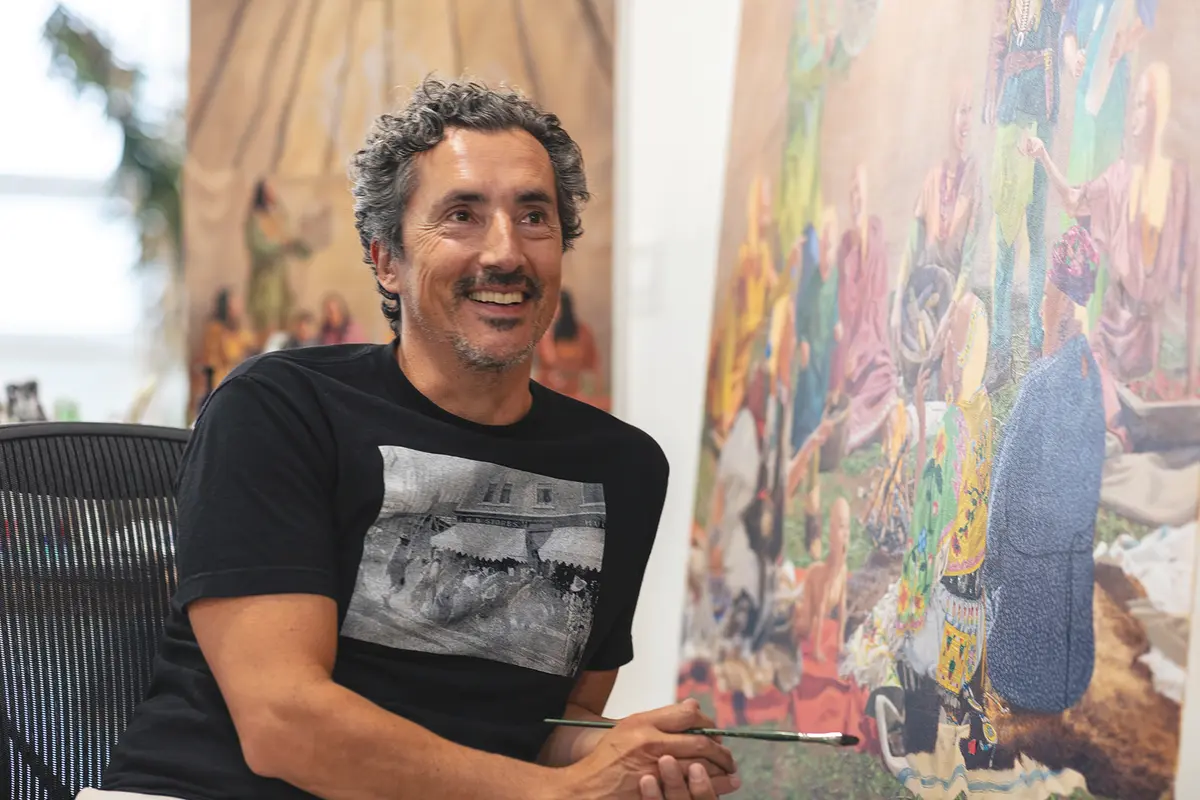
Courtesy of Kent Monkman Studio / Michael Seleski
Kent Monkman is a renowned Canadian Indigenous Artist of the Cree tribe, who is widely known for his involvement and contributions to Western European and American art history. He was born on November 13, 1965, in Saint Marys, Ontario and was raised in Manitoba. Located in Manitoba’s Interlake Region, he is a member of the Fisher River band/nation. Monkman works in painting, film, and installation. He was especially interested in creating art from a very young age. He studied illustration through a commercial art program at Sheridan College when he was 17 and graduated in 1986. In addition, he attended numerous other Canadian and US institutions, including the Banff Centre, the Sundance Institute, and the Canadian Screen Training Institute.
As a First Nations child growing up in Manitoba, it was obvious to Monkman that he was disconnected from his Aboriginal cultural traditions. Affected by the common feelings of dispossession, he found himself relatable to other Indigenous peoples who also lived and continued to live in Canadian urban cities. He discovered himself attracted to 19th-century landscape paintings by famous artists including Edward Church, Thomas Cole, and Albert Bierstadt, and incorporated elements of their styles into his own art. Monkman also favored the way artists like Cornelius Krieghoff, Paul Kane and Peter Rindisbacher glamorized the idealized traditions and lifestyles of the Indigenous peoples while also presenting post-contact Canadian residents as “exotic organisms.” Additionally, George Catlin, an American painter and journalist, was a significant early influence on Monkman because he painted appealing and sympathetic portraits of American Indigenous peoples.
For his mature works, Monkman decided to continue pursuing the styles of 19th-century Romanticist art. Within his works, Monkman combines the historical Canadian landscape with creative, narrative imagery. To create ironic and humorous representations of historical attitudes toward Indigenous culture, he utilizes his recreations of earlier works. Monkman’s alter ego, the gender-fluid Miss Chief Eagle Testickle, who is portrayed as a “time-travelling, shape-shifting, supernatural being,” frequently appears in his art. Monkman’s rich, mural-sized paintings illustrate oddly inverted narratives between First Nations and settlers’ interactions. He masterfully explores and pursues themes of homosexuality, colonization, loss, resilience, and the experiences of historical and contemporary Indigenous peoples. Monkman’s paintings of Indigenous and White males’ interactions are intended to spread the idea of how White people still expect to culturally dominate over the Indigenous.
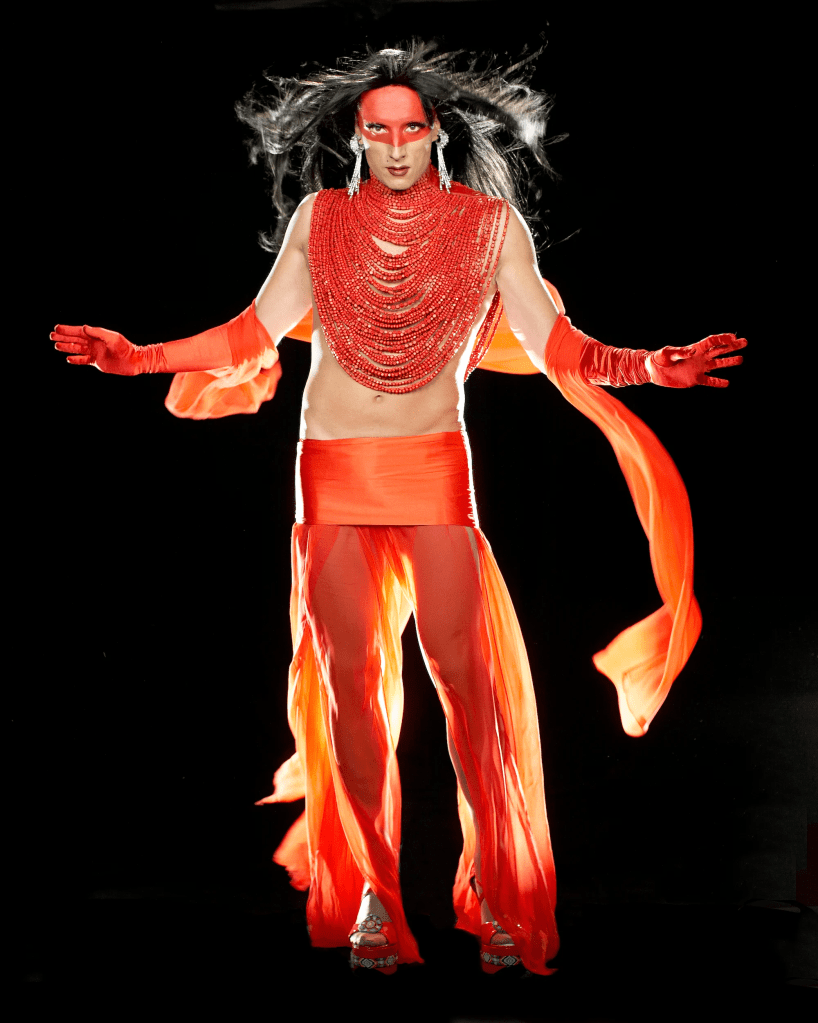
Kent Monkman, Dance to Miss Chief (film still), 2010, film, 4:49 minutes, colour, English and German with English Subtitles.
Monkman’s paintings and works have been exhibited in several institutions throughout Canada, the United States, and Europe, including the Montreal Museum of Fine Arts, the Winnipeg Art Gallery, the Art Gallery of Hamilton, the McMichael Canadian Art Collection, and the Royal Ontario Museum.
Monkman’s awards include the Egale Leadership Award; the Indspire Award, for the arts category; the Outstanding Achievement as an Artist, Hnatyshyn Foundation Visual Arts Award; the Bonham Centre Award, for sexual diversity studies; the Honorary Doctorate, for OCAD University; and the Individual Arts Award, for Premier’s Awards for Excellence in the Arts.
 Aboriginal's Palette